Streamlining Low-Content Publishing: The Strategic Value of KDP Recipe Journal 01 Interior
The landscape of self-publishing has undergone a significant transformation in recent years. What was once a niche hobby for writers has evolved into a sophisticated sector of the digital economy, driven by data-informed creators and entrepreneurs who treat book publishing as a scalable business model. Within this ecosystem, low-content books—specifically functional journals like recipe organizers—have emerged as evergreen assets. However, as the market matures, the barrier to entry shifts from mere access to quality and efficiency. This is where specialized tools like the KDP Recipe Journal 01 Interior play a pivotal role, bridging the gap between creative vision and technical execution for professionals seeking to optimize their workflow.
The Evolution of Functional Publishing in the Digital Age
To understand the relevance of a dedicated interior template, one must first recognize the changing consumer relationship with physical media. Despite the ubiquity of digital recipe apps and cloud storage, there is a persistent, growing demand for tangible, curated organizational tools. Consumers are experiencing digital fatigue; they seek offline spaces that offer tactile satisfaction and focused utility without the distraction of notifications. A recipe journal is no longer just a place to record ingredients; it is a lifestyle artifact that represents culinary heritage, health tracking, and creative expression.
For publishers and marketers, this trend signals an opportunity to create products that serve specific user needs rather than generic placeholders. The KDP Recipe Journal 01 Interior addresses this shift by providing a structured yet flexible foundation. It acknowledges that modern buyers expect professional typography, logical layout flow, and aesthetic coherence, even in low-content formats. By utilizing a pre-validated 6x9 trim size without bleed, creators can bypass the steep learning curve of print formatting while ensuring the final product meets the rigorous quality standards expected by today’s discerning customers.
Technical Precision and Workflow Efficiency
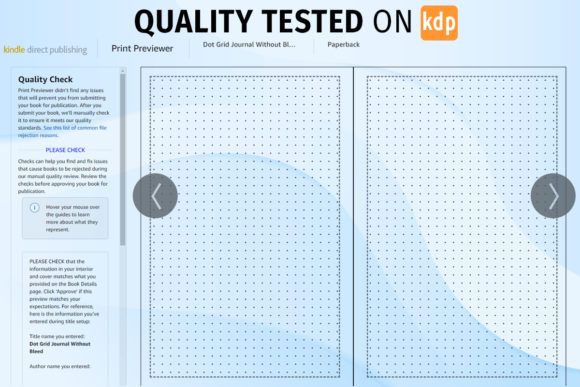
In the professional publishing workflow, time is the most valuable currency. Creating a 120-page interior from scratch involves not only design decisions but also complex technical calculations regarding margins, gutters, and safe zones. Amazon KDP’s printing specifications are exacting, and errors can lead to rejected uploads or poor customer reviews due to misaligned text. The primary value proposition of this template lies in its risk mitigation. Having been quality-tested specifically on KDP, the high-resolution PDF ensures crisp, clear printing, removing the uncertainty that often plagues new publishers.
Beyond the ready-to-upload PDF, the inclusion of source files marks a significant departure from static templates. The provision of both Affinity Publisher (.afpub) and Affinity Publisher Template (.aftemplate) source files, created with version 1.8.3, empowers creators to move beyond simple reselling toward brand building. For freelancers and agencies managing multiple imprints, the ability to quickly customize interiors using master pages and text styles is transformative. This modularity allows for rapid iteration; a creator can adjust fonts to match a specific niche aesthetic or modify header styles to differentiate products within a series, all while maintaining the structural integrity of the original layout.
Anatomy of a High-Converting Interior
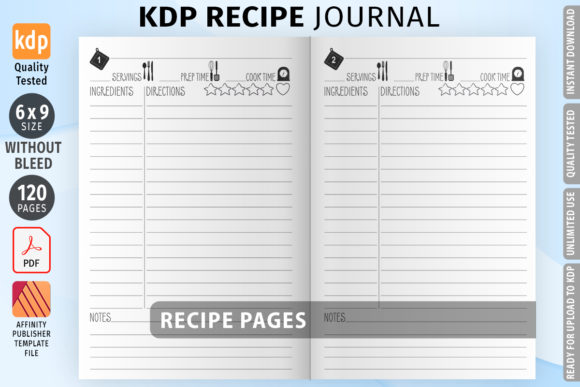
Successful low-content books are defined by their usability. A beautiful cover attracts the click, but the interior secures the sale and generates positive reviews. The architecture of the KDP Recipe Journal 01 Interior demonstrates a thoughtful approach to user experience (UX) in print form. The distribution of content across 120 pages is not arbitrary; it is calibrated for practical daily use.
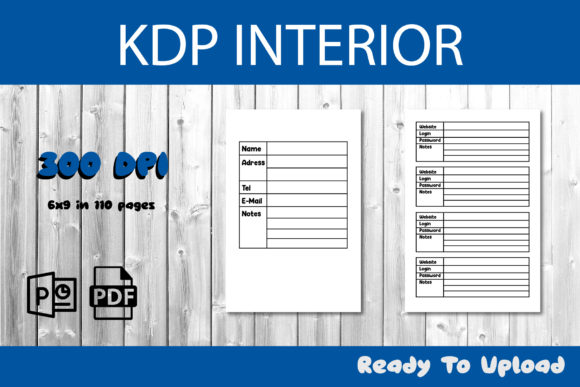
- Organizational Front Matter: The inclusion of a Name and Contact page alongside an optional copyright page establishes ownership and professionalism immediately. The six dedicated Index Pages are critical for functionality, allowing users to categorize recipes efficiently—a feature often missing in generic competitors.
- Core Utility: With 96 dedicated Recipe Pages, the journal offers substantial capacity without becoming unwieldy. This volume strikes a balance between perceived value and manufacturing cost, optimizing the royalty potential for the publisher while providing adequate space for the end-user.
- Emotional Engagement: The single Decorative Quote Page serves as a psychological anchor, elevating the book from a mere notebook to a gift-worthy item. While the graphic itself is not editable, its presence adds necessary whitespace and visual relief, enhancing the overall reading experience.
- Flexible Back Matter: Eleven Notes pages provide essential overflow space for meal planning, grocery lists, or kitchen conversions, acknowledging that real-world usage rarely fits perfectly into predefined boxes.
This deliberate structuring reflects a deep understanding of the end-user's journey, transforming a simple template into a comprehensive product solution.
The Role of Source Files in Brand Differentiation
A common criticism of the low-content publishing space is saturation. When thousands of sellers use identical templates, differentiation becomes impossible. The inclusion of customizable Affinity Publisher files directly counters this commoditization. For entrepreneurs and marketers, these source files represent intellectual property leverage. Instead of being locked into a single design, professionals can adapt the KDP Recipe Journal 01 Interior to serve diverse micro-niches.
Consider the practical application: a marketer targeting vegan home cooks might adjust the text styles to emphasize plant-based terminology, while another targeting baking enthusiasts might repurpose the notes section for temperature conversion charts. Because the template utilizes master pages, these global changes can be applied across all 96 recipe pages in seconds. This capability aligns with broader industry trends toward personalization and niche specificity. It enables creators to build cohesive brands where every product feels intentional and tailored, rather than mass-produced.
Furthermore, reliance on Affinity Publisher reflects a strategic choice in software ecosystems. As a professional-grade alternative to subscription-based models, Affinity Publisher appeals to independent creators who prioritize long-term asset ownership and cost efficiency. Providing files in this format signals an understanding of the target audience’s preferences and technological constraints.
Navigating the Digital Product Economy
It is crucial to emphasize that this product exists within the digital download economy. For buyers, this means instant access and immediate implementation. There is no shipping delay, no physical inventory to manage, and no waiting for proofs before beginning customization. This immediacy supports the agile workflows favored by modern solopreneurs and small teams. However, it also places a premium on file quality and documentation.
The assurance that the PDF is "ready for upload to KDP" with "no editing required" serves as a vital trust signal. In a marketplace flooded with poorly formatted files, verified quality acts as a competitive moat. Professionals understand that fixing formatting errors post-upload can damage account standing and waste advertising spend. By validating the file against KDP’s current specifications, the template provider absorbs the technical risk, allowing the buyer to focus entirely on marketing, keyword research, and cover design.
Future-Proofing Creative Assets
Looking forward, the intersection of AI-generated content and human-curated experiences will define the next phase of publishing. While AI can generate text and images, it currently lacks the nuanced understanding of physical book ergonomics and emotional resonance that a well-designed template provides. Tools like the KDP Recipe Journal 01 Interior represent the human infrastructure upon which future creative businesses will be built.
As consumer expectations continue to rise, the definition of "low content" is expanding to mean "high utility." The days of blank lined notebooks dominating bestseller lists are fading. Success now belongs to those who offer structured solutions to specific problems. By leveraging professionally designed, customizable interiors, creators position themselves at the forefront of this quality revolution. They are not merely selling paper; they are selling organization, memory preservation, and culinary joy, packaged in a format that respects both the creator’s time and the reader’s experience.
Ultimately, investing in a robust template system is an investment in scalability. Whether you are a freelancer expanding your service offerings, an author diversifying your income streams, or a marketer testing new niches, having a reliable, editable, and validated foundation is essential. The KDP Recipe Journal 01 Interior exemplifies this principle, offering a blend of technical safety, creative flexibility, and market-aligned design that supports sustainable growth in the evolving world of print-on-demand publishing.