Hexagonal Grid Paper Letter Light Gray: Optimizing Layouts for Print and Digital Design
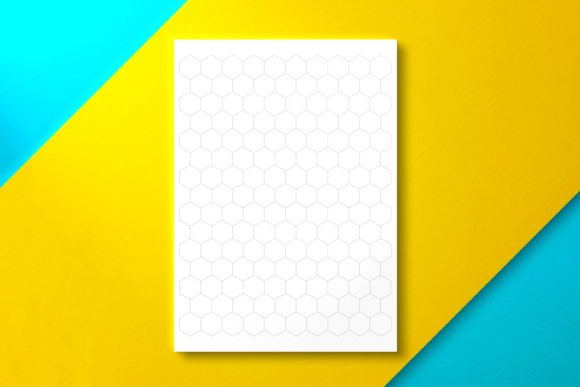
The transition from standard square graph paper to hexagonal layouts represents a significant shift in how professionals, educators, and creators organize spatial information. While traditional grids excel at Cartesian coordinates, the Hexagonal Grid Paper Letter Light Gray format offers distinct advantages for organic modeling, isometric projection, and specialized data visualization. Utilizing a Letter size (8.5 x 11 inches) canvas with light gray guidelines ensures that the grid supports the content without competing for visual attention. This specific configuration has become a staple in fields ranging from chemical engineering to tabletop game design, necessitating high-quality, print-ready resources that adhere to precise dimensional standards.
Strategic Advantages of Light Gray Guidelines on Letter Stock
The choice of line color and paper size is not merely aesthetic; it is functional. In professional documentation and creative drafting, contrast management is paramount. Dark black grid lines often create visual noise that interferes with handwriting, digital overlays, or printed text. A light gray grid provides the necessary structural reference while receding into the background once content is applied. This subtlety is particularly important when using Hexagonal Grid Paper Letter Light Gray for client-facing documents or educational handouts where readability takes precedence over the underlying geometry.
Furthermore, the Letter size (8.5" x 11") remains the standard for North American business, academic, and publishing environments. Unlike A4 or oversized tabloid formats, Letter-sized hexagonal paper integrates seamlessly into standard binders, filing systems, and KDP (Kindle Direct Publishing) trim sizes. For self-publishers and content creators preparing manuscripts for Amazon KDP, adhering to this dimension eliminates costly resizing errors and ensures that margins remain consistent across both digital and physical distributions. The availability of pre-formatted PDF files in this specific size streamlines the production workflow, removing the technical friction often associated with custom page setup.
Differentiating Grid Densities: 1 cm vs. 2 cm Scales
Selecting the appropriate grid density is critical for the intended application. The product suite offering both 1 cm and 2 cm variations addresses two distinct categories of user needs. Understanding the practical difference between these scales prevents wasted resources and ensures the final output matches the user's precision requirements.
High-Precision Applications with 1 cm Hexagons
The 1 cm hexagonal grid serves as a high-resolution canvas. This density is ideal for detailed technical work where fine motor control and exact measurements are required. Users typically leverage this scale for:
- Molecular Modeling: Chemistry students and researchers use 1 cm grids to draw accurate benzene rings and complex organic structures where bond angles must be precise.
- Detailed Cartography: Mapmakers creating regional maps benefit from the tighter mesh, allowing for more granular terrain features and boundary definitions within the Letter page constraints.
- Intricate Pixel Art: Digital artists printing templates for "hexel" art require smaller cells to achieve higher image resolution on a single sheet of paper.
- Engineering Schematics: Drafting isometric components often demands a denser grid to capture small mechanical details without scaling up to larger paper sizes.
Broad-Scale Planning with 2 cm Hexagons
Conversely, the 2 cm hexagonal grid prioritizes macro-level organization and accessibility. The larger cell size reduces visual clutter and accommodates larger handwriting or broader conceptual mapping. Common implementations include:
- Classroom Instruction: Younger students or individuals with motor skill challenges find larger hexagons easier to navigate for early geometry lessons and pattern recognition.
- Game Board Prototyping: Tabletop designers use 2 cm grids to quickly sketch movement ranges and zone control areas that correlate to standard miniature base sizes.
- Project Management: Agile teams utilizing hex-based Kanban boards or dependency maps prefer the spacious layout for writing task summaries directly inside the cells.
- Quilting and Textile Design: Crafters planning tessellated patterns often use 2 cm scales to visualize fabric cuts and seam allowances more clearly.
Commercial Readiness and KDP Compliance
For entrepreneurs and publishers, the utility of Hexagonal Grid Paper Letter Light Gray extends beyond personal use to commercial product creation. The "Ready Commercial Use" designation is a critical specification for those intending to sell physical notebooks, journals, or activity books. Many generic grid templates found online carry restrictive licenses that prohibit resale or require attribution. Securing files explicitly cleared for commercial exploitation protects sellers from intellectual property disputes and platform bans.
When preparing for KDP upload, file integrity is non-negotiable. The provided PDF files are optimized for print-on-demand specifications, ensuring that the light gray lines reproduce consistently without banding or pixelation. KDP’s printing process can sometimes darken light elements; however, professionally calibrated light gray hex grids are tested to maintain their subtle appearance after binding. Additionally, the inclusion of both single-page and 100-page bulk files facilitates rapid book interior assembly. Creators can use the single-page files for testing cover alignment and margin safety zones before committing to the full 100-page manuscript compilation, significantly reducing proofing costs and time-to-market.
Technical Workflows Across Professional Disciplines
The versatility of hexagonal letter-size paper manifests differently across various sectors. Unlike square grids which imply orthogonal relationships, hex grids suggest connectivity, flow, and three-dimensional depth. This inherent geometric bias influences how different professionals utilize the medium.
STEM Education and Research
In scientific contexts, the hexagon is the language of nature. From honeycomb structures to crystal lattices, hexagonal symmetry is fundamental. Educators utilizing Hexagonal Grid Paper Letter Light Gray provide students with a scaffold that mirrors real-world molecular geometry rather than forcing organic shapes onto artificial square boxes. Researchers also use these grids for data clustering visualization, where the six-point adjacency of hexagons offers a more accurate representation of nearest-neighbor relationships than four-point square adjacency. The light gray tone allows for color-coding data points or molecular bonds without the underlying grid distorting the color perception.
Game Design and Interactive Media
Tabletop gaming relies heavily on hex grids for movement mechanics because they eliminate the ambiguity of diagonal movement present in square grids. Designers prototyping new rule sets need printable, standardized surfaces to test balance and playability. The Letter size format is particularly useful for creating modular map tiles or player reference sheets that fit into standard card sleeves or rulebooks. The 2 cm variant specifically aligns well with common miniature wargaming standards, making it a direct tool for playtesting rather than just theoretical design.
Artistic Composition and Tessellation
Artists exploring M.C. Escher-style tessellations or Islamic geometric patterns require precise underlying guides. Hexagonal grids serve as the foundational skeleton for these complex interlocking designs. The light gray color is essential here; it acts as a temporary guide that can be ignored during inking or coloring phases. Because the grid is mathematically perfect, artists can focus entirely on the creative adaptation of forms within the cells, trusting that the symmetry will hold. The availability of 1 cm grids enables highly detailed, meditative artwork suitable for adult coloring books or gallery prints.
File Organization and Implementation Best Practices
Maximizing the value of this resource requires proper file management and printing considerations. The product package includes four distinct file types designed to cover the spectrum of usage scenarios. Understanding when to deploy each file prevents workflow bottlenecks.
- Single Page Verification: Always begin by printing the 1-page Hexagonal Grid Letter files (both 1 cm and 2 cm). Use these to verify printer scaling settings. Ensure "Actual Size" or "100%" is selected in the print dialog to prevent the hexagons from distorting into ovals or shifting off-center.
- Bulk Production: Once calibration is confirmed, utilize the 100-page PDF files for batch printing or digital book assembly. These files are typically optimized for faster processing by RIP (Raster Image Processor) software used in commercial printing.
- Digital Annotation: For users importing these PDFs into tablet apps like GoodNotes or Notability, the light gray hex grid serves as an excellent non-distracting background. The Letter size aspect ratio fits standard iPad screens reasonably well, though users may need to adjust zoom levels depending on whether they chose the 1 cm or 2 cm density.
- Binding Considerations: If physically binding the 100-page sets, account for gutter margins. While the PDF files are Letter size, the usable hex area should respect the inner margin if the document will be saddle-stitched or perfect bound. The light gray grid helps visually identify safe zones during the trimming process.
Evaluating Quality in Geometric Templates
Not all hexagonal grid papers are created equal. When assessing resources for professional or commercial use, several quality indicators distinguish superior products from substandard ones. Line weight consistency is primary; the gray lines must be uniform across the entire 8.5 x 11 surface. Variations in opacity can cause scanning artifacts or uneven printing results. Furthermore, true geometric accuracy is mandatory. A "hexagonal" grid that is actually composed of stretched polygons will ruin isometric projections and molecular diagrams. The vertices must meet precisely, and the internal angles must be exactly 120 degrees.
The integration of Hexagonal Grid Paper Letter Light Gray into professional workflows demonstrates a maturation of niche design tools. By providing specific, commercially cleared, and dimensionally accurate resources, creators and professionals can bypass the tedious process of manual grid generation. Whether facilitating a chemistry lesson, prototyping a strategy game, or compiling a low-content book for KDP, the right grid foundation transforms abstract concepts into tangible, organized realities. The distinction between 1 cm and 2 cm scales further ensures that the tool adapts to the task, rather than forcing the task to adapt to the tool.