Evaluating Hexagonal Grid Paper Letter Yellow for Design and Publishing
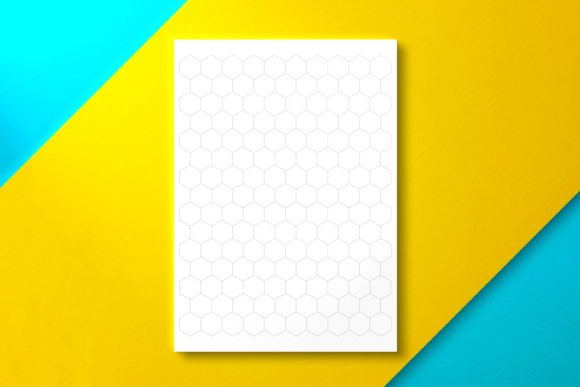
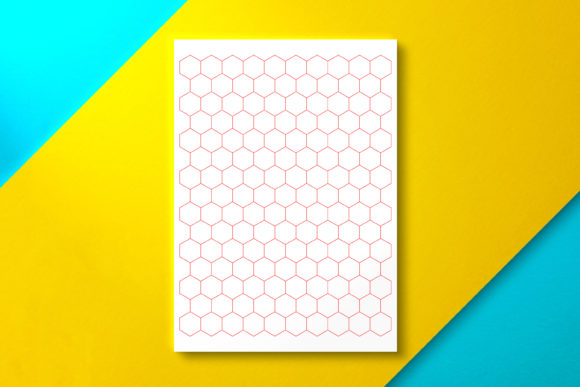
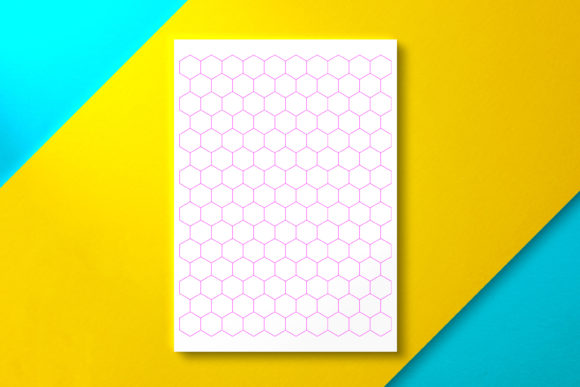
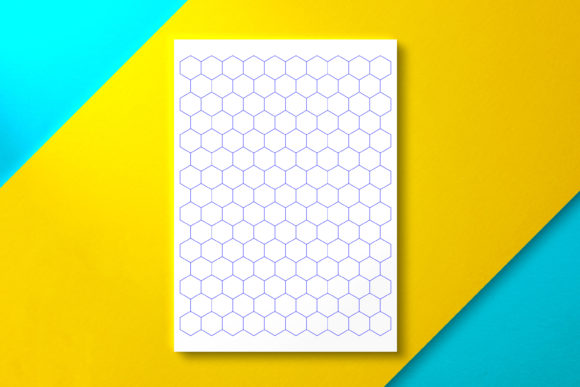
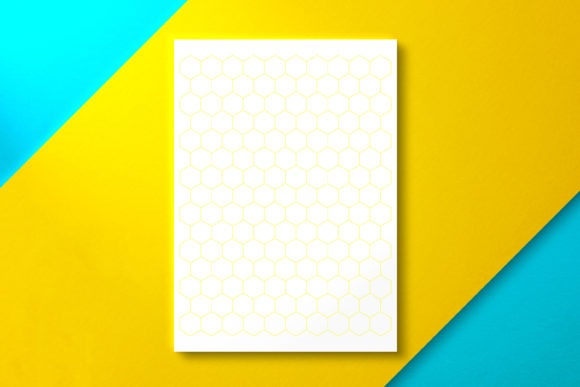
Selecting the appropriate background template is a foundational step for creators developing notebooks, technical journals, or educational materials. Hexagonal Grid Paper Letter Yellow offers a specific aesthetic and functional combination that differs significantly from standard graph or lined paper. This resource typically arrives in PDF format sized at 8.5 x 11 inches (Letter), featuring yellow grid lines available in 1cm and 2cm variations. For designers and self-publishers, particularly those utilizing Amazon KDP, understanding the practical applications and limitations of this specific grid style is essential before integrating it into a commercial product.
Functional Characteristics of Yellow Hexagonal Grids
The primary distinction of hexagonal grid paper lies in its geometry. Unlike square grids that enforce orthogonal thinking, hexagons facilitate isometric projection and organic flow. The yellow coloration serves a dual purpose: it provides sufficient contrast for digital viewing and printing while remaining subtle enough not to overpower handwritten content or sketches. In professional drafting and design contexts, yellow lines are often preferred because they reproduce as light gray or disappear entirely when photocopied or scanned in black and white, keeping the focus on the user's ink.
The availability of two distinct sizes—1cm and 2cm—addresses different use cases within the Letter size format. The 1cm grid offers higher density, suitable for detailed molecular diagrams, intricate pixel art, or precise technical schematics where fine granularity is required. Conversely, the 2cm grid provides ample negative space, making it ideal for broader conceptual mapping, larger handwriting, or visual brainstorming sessions where clarity and openness take precedence over precision. Evaluating which size aligns with your target audience’s intent is the first critical decision point.
Commercial Viability and KDP Readiness
For publishers assessing this asset for Amazon KDP or similar print-on-demand platforms, "Ready Commercial Use" indicates that the licensing permits inclusion in products intended for sale without additional royalty payments. However, technical readiness extends beyond legal permissions. A KDP-ready file must adhere to strict margin and bleed requirements. When evaluating these PDF files, verify that the grid extends appropriately to the trim line if a bleed is desired, or maintains safe margins if the design is non-bleed.
The product structure typically includes both single-page masters and pre-compiled 100-page books. This segmentation supports different workflow strategies. Single pages allow designers to create custom interiors by mixing grid sizes or inserting instructional content between blank templates. Pre-compiled 100-page documents serve as immediate baselines for low-content books, reducing production time. When comparing options, consider whether your publishing strategy relies on uniformity or customization. Uniform books benefit from the pre-made files, while niche journals requiring unique layouts necessitate the single-page assets.
Situations Where Hexagonal Grids Excel
Hexagonal Grid Paper Letter Yellow is particularly effective in specific niches where traditional linear formats fail to capture spatial relationships. Understanding these strong-fit scenarios helps determine market viability:
- Chemistry and Molecular Modeling: The hexagonal lattice naturally mirrors benzene rings and organic chemistry structures, making this paper superior to square graph paper for students and researchers.
- Isometric Art and Architecture: Artists creating 3D illusions on 2D surfaces rely on hex grids to maintain correct perspective angles without complex guidelines.
- Game Design and Mapping: Tabletop RPG maps and board game prototypes frequently use hex grids for movement mechanics. Yellow lines allow game masters to draw terrain features clearly without grid interference.
- Mind Mapping and Flowcharts: The six connection points of a hexagon offer more directional flexibility than the four points of a square, supporting non-linear thought processes.
If your target demographic overlaps with these fields, the specialized nature of this paper adds tangible value compared to generic alternatives.
Tradeoffs and Limitations to Consider
Despite its utility, hexagonal grid paper presents specific constraints that may make it unsuitable for certain projects. Objective evaluation requires acknowledging these tradeoffs:
- Writing Difficulty: Standard handwriting is designed for horizontal baselines. Writing paragraphs on a hex grid can be disorienting and messy. This format is poor for journaling-heavy products unless combined with lined sections.
- Printing Sensitivity: Yellow ink density varies significantly between digital printers. On some home printers, yellow may appear too faint to see; on commercial presses, it may shift toward orange. Always order a physical proof before launching a KDP title to ensure the grid remains visible but unobtrusive.
- Niche Appeal: The market for hex paper is smaller than lined or dot grid paper. Sales volume may be lower, though competition is also reduced. Evaluate whether the specialized demand justifies the narrower audience.
- Digital Compatibility: While optimized for print, yellow hex grids can cause eye strain on backlit screens. If marketing a digital version for tablet users, consider offering a darker gray alternative alongside the yellow print-optimized version.
Comparing Alternatives and Making Decisions
When deciding whether to proceed with Hexagonal Grid Paper Letter Yellow, compare it directly against potential substitutes based on end-user goals. If the primary function is note-taking with occasional diagrams, dot grid paper may offer a better balance of structure and freedom. If the focus is purely mathematical graphing, standard Cartesian graph paper remains the industry standard. Hex grids occupy a specialized middle ground best suited for visual-spatial tasks rather than text-dominant ones.
Additionally, evaluate the source quality. Not all hex grids are geometrically perfect. Distorted hexagons ruin isometric drawings and frustrate technical users. Before committing to a commercial release, test the geometric accuracy by printing a page and measuring multiple cells across the sheet. Ensure the 1cm and 2cm measurements are true and consistent throughout the Letter-sized canvas.
Ultimately, the decision should hinge on alignment between the grid’s properties and the intended user experience. Hexagonal Grid Paper Letter Yellow is a functional tool for specific creative and technical workflows. Its value proposition lies in facilitating spatial visualization that other formats cannot support. By carefully weighing the printing considerations, size appropriateness, and niche applicability against the limitations of writing comfort and market size, creators can make an informed choice about integrating this asset into their product lineup. Success depends less on the novelty of the yellow hexagon and more on solving a genuine problem for a defined audience segment.