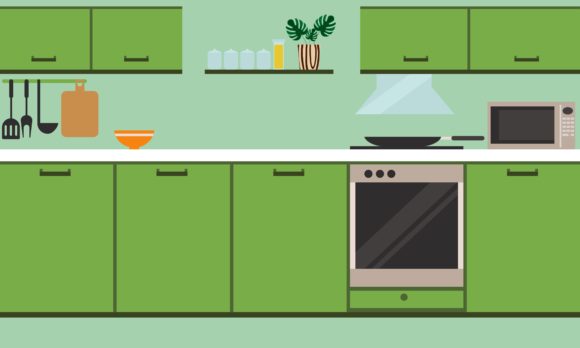
Modern Kitchen Interior Vector Assets: Bridging Conceptual Design and Technical Execution
The evolution of residential architecture has placed the kitchen at the absolute center of domestic life, transforming it from a purely utilitarian space into a multifaceted hub for social interaction, culinary artistry, and aesthetic expression. For designers, architects, and content creators tasked with visualizing these complex environments, the precision of line work and the flexibility of format are paramount. Utilizing a Modern Kitchen Interior Vector resource provides a foundational advantage in this visualization process. Unlike raster-based photography or static 3D renders, vector graphics offer an infinite scalability and editability that aligns perfectly with the iterative nature of contemporary design workflows. When these assets are provided in dual formats, specifically JPG and EPS, they cater to a remarkably broad spectrum of users, from professional interior designers using industry-standard CAD software to educators creating instructional materials for spatial planning.
The Strategic Value of Dual-Format Accessibility
The inclusion of both JPG and EPS file types within a single download package addresses the fragmented nature of modern creative toolchains. This duality is not merely a convenience; it is a functional necessity that dictates how the asset can be integrated into various projects. Understanding the distinct roles of each format allows users to maximize the utility of their Modern Kitchen Interior Vector collection without encountering technical bottlenecks.
EPS Files: The Professional Standard for Manipulation
The Encapsulated PostScript (EPS) format serves as the master source file for any serious design modification. Because EPS is a vector-based format, it stores image data as mathematical equations rather than a grid of pixels. This characteristic yields several critical advantages for kitchen design:
- Infinite Scalability: A kitchen elevation or floor plan can be resized from a business card dimension to a billboard-sized presentation board without any loss of fidelity or pixelation. This is essential for architects who must produce drawings at multiple scales.
- Element Isolation: In a modern kitchen illustration, individual components such as cabinetry, island units, pendant lighting, and appliances often exist on separate layers. Users can select, move, recolor, or delete specific elements to customize the scene to match a client’s specific layout.
- Color Profile Management: Professional print workflows require CMYK color separation. EPS files retain native CMYK data, ensuring that the slate greys, matte blacks, and warm wood tones typical of modern kitchens reproduce accurately in physical brochures and signage.
- Line Weight Consistency: Architectural drafting relies on hierarchical line weights to denote depth and materiality. Vector paths maintain crisp edges regardless of zoom level, preserving the technical integrity of the drawing.
JPG Files: Immediate Visualization and Compatibility
While the EPS file offers malleability, the JPG (Joint Photographic Experts Group) file provides immediate accessibility. Not every stakeholder in a kitchen renovation project possesses vector editing software or the technical expertise to navigate layer structures. The JPG serves as the universal translator for these assets:
- Universal Viewing: Clients, contractors, and real estate agents can open JPGs on any device, including smartphones and tablets, facilitating quick feedback loops during remote consultations.
- Web and Digital Integration: For bloggers, researchers, and digital marketers, the JPG is optimized for web use. It allows for the rapid embedding of high-quality kitchen visuals into articles, mood boards, and social media posts without requiring conversion tools.
- Reference Material: Even for professionals working in the EPS environment, having a flattened JPG reference is valuable for checking overall composition and color balance before beginning detailed edits.
Defining Aesthetics Through Vector Precision
The term "modern" in kitchen design encompasses a specific set of architectural principles that vector graphics are uniquely suited to represent. Raster images often struggle to capture the clean lines and geometric purity required by this style without introducing noise or compression artifacts. A high-quality Modern Kitchen Interior Vector captures these nuances through deliberate path construction.
Minimalism, a cornerstone of modern design, relies heavily on negative space and uncluttered surfaces. Vector illustrations excel here because they do not carry the visual baggage of photographic texture unless explicitly designed to do so. This allows the viewer to focus on form, proportion, and spatial relationships. For example, handle-less cabinetry systems, integrated appliances, and monolithic island structures are rendered with mathematical exactness. This clarity helps homeowners and designers visualize the "flow" of a kitchen without being distracted by temporary styling or photographic imperfections.
Furthermore, modern kitchens frequently employ mixed materials—combining cold industrial elements like stainless steel and concrete with warmer organic touches like walnut veneer or terrazzo. Vector art allows for the stylized representation of these textures. Instead of photorealistic rendering, which can sometimes look sterile or artificial in 2D, vector art uses gradients, patterns, and opacity masks to suggest materiality. This abstraction invites the viewer to imagine the tactile quality of the space, making it an effective tool for conceptual presentations where the exact finish has not yet been selected.
Workflow Integration Across Disciplines
The versatility of these graphics extends far beyond traditional interior design. The ease of application with any software means that diverse professionals can leverage these assets to enhance their specific outputs.
Architectural and Interior Design Firms
For design professionals, time is the most constrained resource. Creating custom illustrations for every client presentation is cost-prohibitive. Downloadable vector assets serve as high-quality base templates. A designer might import an EPS file of a generic modern kitchen layout and then overlay their specific floor plan, swap out fixture symbols, and adjust the color palette to match the client's selections. This hybrid approach reduces drafting time by hours while maintaining a bespoke appearance. Additionally, these vectors are invaluable for creating detail drawings and joinery diagrams where clarity supersedes photorealism.
Real Estate and Property Development
In off-plan sales and renovation marketing, the ability to show potential buyers what a space could look like is crucial. Developers often use Modern Kitchen Interior Vector graphics in brochures and hoardings because they print crisply at large formats. Unlike 3D renders, which can become dated quickly as trends shift, clean vector illustrations have a timeless, diagrammatic quality that focuses on spatial volume rather than fleeting decor trends. The JPG versions are equally vital for MLS listings and digital flyers, providing instant visual context for properties undergoing renovation.
Education and Academic Research
Educators in architecture, interior design, and vocational trades utilize these graphics as teaching aids. Analyzing a vector drawing allows students to deconstruct kitchen ergonomics, circulation patterns, and zoning principles. Because the files are editable, instructors can modify layouts to create problem-solving exercises, asking students to identify code violations or optimize inefficient workflows. Researchers studying housing trends or ergonomic standards can also use standardized vector assets to illustrate findings in academic papers and journals, ensuring that visual data is consistent and professionally presented.
Content Creation and Publishing
Bloggers, magazine editors, and textbook authors require imagery that supports narrative text without infringing on copyright or suffering from low resolution. The licensing clarity and technical quality of dedicated vector downloads solve common publishing headaches. A writer covering the rise of sustainable kitchen materials can use a vector illustration to highlight areas where recycled glass countertops or bamboo cabinetry would be installed, using callouts and annotations directly on the vector artwork. The ability to easily apply these graphics in layout software like Adobe InDesign or even Microsoft Publisher ensures that the final publication maintains a cohesive visual identity.
Technical Considerations for Optimal Application
While these graphics are designed to be user-friendly, achieving the best results requires adherence to certain technical best practices. Users should be aware of font dependencies when opening EPS files. If the original designer used proprietary fonts that are not installed on the user's system, the software may substitute them, potentially altering the appearance of labels or dimensions. To mitigate this, many high-quality vector packs outline text, converting it to shapes, though this sacrifices editability. Users intending to change text should verify whether fonts are live or outlined.
Color mode awareness is another critical factor. Modern kitchens are often depicted in sophisticated neutral palettes that rely on subtle tonal shifts. Converting an RGB-designed vector to CMYK for print can sometimes result in color shifting, particularly in vibrant accent colors or deep shadows. Professionals should always perform a soft-proof check before sending files to print. Conversely, using a CMYK EPS file for web display may result in dull colors; in such cases, exporting a fresh JPG from the EPS in RGB mode is recommended.
Layer organization significantly impacts workflow efficiency. Before purchasing or downloading a Modern Kitchen Interior Vector, it is advisable to review the product description regarding layer structure. Well-organized files group elements logically (e.g., "Flooring," "Upper Cabinets," "Lighting," "Decor"), whereas poorly organized files may have all elements merged onto a single layer, negating many of the benefits of the vector format. For users new to vector software, starting with the JPG to understand the composition before attempting to dissect the EPS can provide a helpful roadmap for navigation.
The Role of Abstraction in Client Communication
One often-overlooked advantage of using vector graphics over photorealistic rendering in kitchen design is the psychological effect of abstraction. When clients see a hyper-realistic 3D render, they tend to fixate on specific details: the exact shade of the backsplash, the brand of the faucet, or the styling of the countertop accessories. This can lead to premature decision-making or dissatisfaction if the final product varies slightly from the render.
Vector illustrations, by their nature, communicate intent rather than finality. They function as a collaborative canvas. When a designer presents a clean, stylized vector elevation of a modern kitchen, the client understands that this is a representation of space and proportion. This leaves room for dialogue and adjustment. It positions the designer as a guide rather than a dictator of taste. The graphic becomes a communication tool that facilitates understanding of the underlying architectural logic—the relationship between the cooking zone and the social zone, the balance of vertical and horizontal lines, and the integration of storage solutions. In this way, the Modern Kitchen Interior Vector is not just a picture of a room; it is a catalyst for successful project outcomes, bridging the gap between abstract ideas and tangible reality through accessible, high-fidelity visual language.